AdaBoost (Adaptive Boosting)
AdaBoost (Adaptive Boosting) is an ensemble machine learning algorithm that sequentially merges multiple weak learners known as Decision Stumps (trees with only one split and two terminal leaves) into a single strong classifier. .
Every time a stump is built, the algorithm's adaptive re-weighting mechanism looks at which data points it misclassified, increases their weight (importance), and lowers the importance of the correctly classified points.
- In Random Forest each time you make a tree, you make a full sized tree. Some trees might be bigger than others, but there is no predetermined maximum depth.
- Each Decision Tree in Random Forest, can use all the variables.
- In RF, each tree has equal vote in final classification.
- Each Tree in RF are made independent to other trees.
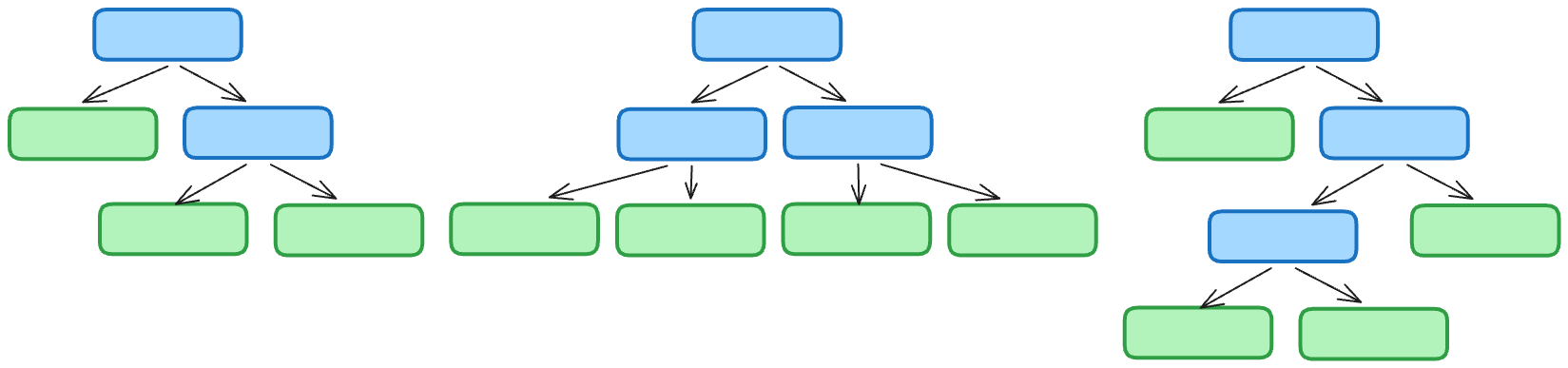
- In contrast, in AdaBoost, the trees are usually just a node and two leaves. (a.k.a "Stump").
- Stumps can only use one variable for making decision, and thus each stump is a "weak learner"
- In contrast, in a Forest of Stumps made with AdaBoost, some stumps get more say in the final classification than others.
- In Forest of Stumps made by AdaBoost, order is important. The errors that the first stump makes... influence how second stump is made and so on..

Reference: AdaBoost vs Random Forest
Stumps
- Stumps can only use one variable for making decision, and thus each stump is a "weak learner"
Three Core Principles of AdaBoost
-
Combines Weak Learners: AdaBoost merges many "weak learners" (models slightly better than random guessing) to make classifications. The weak learners are almost always decision stumps (trees with only one split).
-
Weighted Voting: Some stumps get more say in the final classification than others, based on their accuracy. Better-performing stumps have higher influence.
-
Sequential Learning: Each stump is built by taking the previous stump's mistakes into account. Misclassified samples receive higher weights, forcing the next stump to focus on these harder cases.
How AdaBoost Works: Step-by-Step
The Core Mechanism
AdaBoost is like a persistent teacher who keeps creating customized quizzes for students who struggle, while letting students who already understand practice on their own. The algorithm focuses its attention where it's needed most.
The Algorithm Process
Step 1: Initialize Sample Weights
- Begin with all training samples having equal importance (weight)
- Each sample weight:
where is the total number of samples - Example: For 8 samples, each weight =
Step 2: Build a Weak Learner (Decision Stump)
- Train a weak learner, typically a decision stump (one split decision tree)
- Evaluate each feature to find the best split using a criterion like Gini index or entropy
- Select the feature and threshold that gives the lowest error
- Even this simple model will get some predictions right and some wrong
Step 3: Calculate Total Error
- Measure the weighted error rate of this classifier
- Error is the sum of weights of misclassified samples:
- This weighted error tells us how much to trust this classifier.
- For equal weights, this simplifies to the proportion of misclassified samples.
Step 4: Calculate Classifier's "Amount of Say" (Alpha)
- Determine how much influence this classifier should have in the final prediction
- The formula is: $$\alpha = \frac{1}{2} \ln\left(\frac{1-\epsilon}{\epsilon}\right)$$
Understanding Alpha (): - If
(perfect classifier): becomes large and positive → strong influence - If
(random guessing): → no influence - If
(always wrong): becomes large and negative → vote gets flipped
Key Insight: The relationship is logarithmic—small improvements in error lead to disproportionately large increases in influence. A classifier with 10% error gets much more weight than one with 40% error.
Step 5: Update Sample Weights (The Adaptive Part)
This is where the "adaptive" in AdaBoost happens:
For misclassified samples:
For correctly classified samples:
Then normalize all weights so they sum to 1:
What This Does:
- Misclassified samples get exponentially higher weights (become more important)
- Correctly classified samples get lower weights (become less important)
- Next classifier will focus more on the currently misclassified samples
Step 6: Create New Training Dataset
- Use updated sample weights as a probability distribution
- Resample the dataset with replacement based on these weights
- Samples with higher weights appear more frequently in the new dataset
- The new dataset has the same size but emphasizes harder-to-classify examples
Step 7: Repeat
- Train next weak learner on the re-weighted dataset
- Continue for a fixed number of iterations or until error becomes too high
Step 8: Make Final Predictions
- Each weak learner votes for a class
- Votes are weighted by their
values (amount of say) - For a sample
, the final prediction is: where is the prediction of the -th weak learner - The class with the highest weighted vote wins
Visual Example
👉 Excellent visual example ➛ StatQuest with Josh Starmer - AdaBoost
AdaBoost Characteristics
Strengths
- Elegantly Simple: Easy to understand and implement
- Minimal Tuning: Only need to choose number of iterations (rounds)
- Strong Theory: Mathematically proven to reduce training error exponentially
- Fast Training: Each weak learner is very simple (often just one split)
- Works Out-of-Box: Good results without extensive hyperparameter tuning
- Handles Non-linearity: Can capture complex decision boundaries with simple stumps
- No Need for Feature Scaling: Tree-based weak learners are scale-invariant
Weaknesses
- Outlier Sensitive: Noise and outliers get increasing weight, causing overfitting
- Binary Classification Focus: Designed for two-class problems; extensions to multi-class are less elegant
- Limited to Classification: Doesn't naturally extend to regression problems
- Surpassed by Modern Methods: XGBoost and LightGBM generally perform better
- Can Overfit: Running too many iterations without stopping can harm generalization
- Sequential Training: Cannot be parallelized like Random Forests
- Sensitive to Label Noise: Mislabeled data points can severely hurt performance
Python Implementation - Demo
Key Mathematical Formulas Reference
| Component | Formula | Description |
|---|---|---|
| Initial Weights | All samples start with equal weight | |
| Weighted Error | Proportion of weighted misclassifications | |
| Stump Influence (Alpha) | How much say this stump gets in final vote | |
| Update Weights (Correct) | Decrease weight for correctly classified | |
| Update Weights (Wrong) | Increase weight for misclassified | |
| Normalize Weights | Ensure weights sum to 1 | |
| Final Prediction | Weighted vote of all stumps |
Questions and Answers
1. How the New Dataset is Created 🔄
There are two primary methods that packages use to feed this "new dataset" into the next stump:
Method A: Proportional Resampling (The Roulette Wheel)
The algorithm creates a brand-new dataset of size
Example: Imagine Data Point #5 was misclassified, so its weight ballooned to 0.40 (40%), while Data Point #2 was easy to classify, so its weight shrank to 0.01 (1%).
When drawing the new dataset, Data Point #5 will likely be copied into the new dataset multiple times, while Data Point #2 might be left out entirely. The next stump is forced to focus on Data Point #5 because it now appears everywhere!
Method B: Weighted Loss Function
Instead of physically copying rows, the original dataset remains identical, but the formula used to calculate the split's impurity (like Gini or Entropy) multiplies each row's penalty by its weight. Misclassifying a high-weight row penalizes the stump heavily.
2. What will happen if the next stump still gets that higher weight point wrong?
If you use Method A (Resampling) and a specific hard-to-classify data point gets duplicated five times into the new dataset, what will happen if the next stump still gets that point wrong?
Answer
The weight will change very slightly (or not at all)! This is one of the most fascinating mathematical quirks of AdaBoost. Here is why:
- High Error Rate: If that duplicated point makes up a huge portion of the dataset and the new stump still gets it wrong, the stump's overall error rate will be very high (close to
or more). - Low Stump Power (
): A stump with a high error rate is no better than a random guess, so its voting power ( ) drops close to . - Small Update: Since the weight update formula multiplies the misclassified weights by
, and , the weights barely change. The algorithm essentially "gives up" on that round because the stump couldn't learn anything useful.