📊 The Statistical Toolbox: Residuals, Correlation, and Determination
🏗️ The Big Three: What are they?
| Concept | The "In Plain English" Definition | Where is it used? |
|---|---|---|
| Residual ( |
The "Error" for a single point. (Actual - Predicted) | To see how "off" we were for one specific person/item. |
| Correlation ( |
The "Direction & Strength" of the relationship. | To see if two things (like height and weight) move together. |
| Determination ( |
The "Success Score" of the whole model. | To tell us what % of the variation we successfully explained. |
🔗 The Connection: How they fit together
Think of it like a puzzle:
- Correlation (
) is the raw relationship between and . - Residuals are the pieces that don't fit the pattern.
- Coefficient of Determination (
) is the final grade for the whole puzzle.
🚦 Usage Summary
- Use
to see if there is a relationship at all. - Use
to see how useful your model is for the big picture. represents the proportion of the total variation in the dependent variable ( ) that is explained by the independent variable ( ). - In other words,
is the "Explained" part of the variation. We find it by subtracting the "Unexplained" ratio from 1
- Use Residual Patterns to see if your model is biased or broken.
- Use Standard Deviation of Residuals (
) to tell someone: "My prediction is probably off by ± [this much] in real units."
Two Ways to Calculate
There are two formulas for
1. The "Shortcut" Method (using Correlation)
- When to use: When you already have the correlation coefficient (
). - Meaning: It tells you that the variance explained is exactly the square of the linear strength.
- Limitation: This only works for Linear Regression with one independent variable.
2. The "Residual" Method (using Sum of Squares)
- When to use: When you have the actual data points and the regression line. This is the most powerful way because it works even for complex models (Multiple Regression).
- Meaning: It calculates:
. - Analogy: If you have 100 gallons of "mystery" (Total Variation) and 15 gallons are still "mysterious" (Residuals) after your explanation, then you explained
.
📉 Deep Dive: Residuals & Variation
1. Residual (
- Meaning: A residual is a measure of how well a line fits an individual data point.
A residual is the vertical distance between an actual data point and the regression line. - Connection: If you sum all your residuals (In Linear Regression) , they should equal zero.
If you square them and add them up, you get the Residual Sum of Squares (), which represents the "unexplained" portion of your model.
- The Goal: In a perfect model, the sum of residuals is always 0.
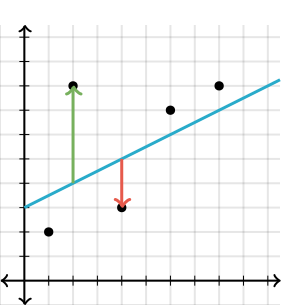 The residual for the point (4,3) is [-2]
The Residual Check
Diagnostic Tool: Scientists plot residuals on a "Residual Plot" to see if there are patterns.
- If they form a "U" shape, a straight line was the wrong choice.
- If the residuals look like a random cloud, the linear model is appropriate.
If you see a pattern in your residuals (like a curves or "fan" shape), stop! Yourmight be high, but your model is fundamentally wrong for the data.
2. Residual Sum of Squares (
- Meaning: This is the Unexplained Variation. This is the variation the line couldn't explain—the distance between the points and the line.
- Connection: Lower
means a higher (a better fit!).
3. Variance of Residuals (
- Meaning: The average squared error. It tells us the "spread" of our mistakes.
4. Standard Deviation of Residuals (
- Meaning: Frequently called the Standard Error of the Estimate.
- Why it's crucial: This is the "Typical Error." If
, it means your predictions are usually off by about 2.5 units. - Use: While
gives you a percentage (relative), gives you an error in the actual units (absolute), like inches or dollars.
5. Root Mean Square Error (
Used to measure Accuracy in the same units as your data.
- Meaning: It is the standard deviation of the residuals. It tells you, on average, how far off your predictions are from the actual values.
- Connection:
is the square root of the average squared residual. - While
tells you the percentage of accuracy (e.g., 89%), RMSE tells you the magnitude of the error (e.g., "Our price prediction is off by $500 on average").
- Often used interchangeably with the standard deviation of residuals in this context
5. Total Variation (
- Meaning: It is the starting baseline for all error calculations. It represents 100% of the movement we are trying to explain. It represents the total "chaos" or spread in your
values relative to their average ( ). - Total Variation (
): This is the sum of squared differences from the mean
🛠️ Working Example (Corrected)
Data points: (1,1), (2,2), (2,3), (3,6)
1: Summary Stats
i. Means (
ii. Standard Deviations (
This measures the "spread" of our data around the mean. We'll use the population formula for this high school example:
iii: Coefficient Correlation (
The correlation
- Interpretation: This is a very strong positive correlation!
2: The Equation of the Regression Line (
- Slope (
): - Intercept (
): - Line:
3: Residual Breakdown Table
| Residual ( |
Squared Residual | Total Variation ( |
|||
|---|---|---|---|---|---|
| 1 | 1 | 0.5 | 0.5 | 0.25 | 4 |
| 2 | 2 | 3.0 | -1.0 | 1.00 | 1 |
| 2 | 3 | 3.0 | 0.0 | 0.00 | 0 |
| 3 | 6 | 5.5 | 0.5 | 0.25 | 9 |
| Sum | 0 |
i. Residual/Unexplained Variation (
4: Total Variation (
It is the starting baseline for all error calculations. It represents 100% of the movement we are trying to explain.
- Meaning: It represents the total "chaos" or spread in your
values relative to their average ( ). - Total Variation (
): This is the sum of squared differences from the mean
5: FINAL Calculation of Coefficient of Determination
- Method 1 (
):
- Method 2 (Residuals):
The Final Analysis
- How much variation is described by
?
- 89.3% of the total variation in
is explained by the variation in (the regression line).
- How much variation is NOT described by
?
.
Interpretation: Only 10.7% of the variation is due to "noise" or other factors not included in our model.
Step 6: Additional Interpretations
- Variance of Residual (
): Average of squared residuals:
- Standard Deviation of Residual (
)
- Root Mean Square Error (
)
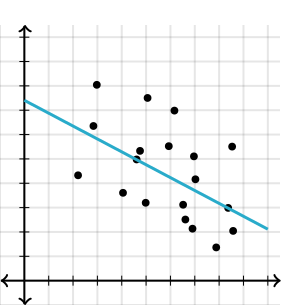
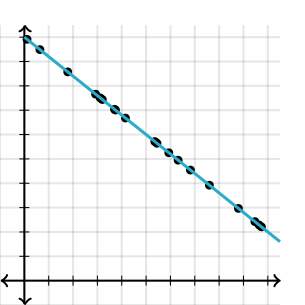
Observations for "Correlation Coefficient"
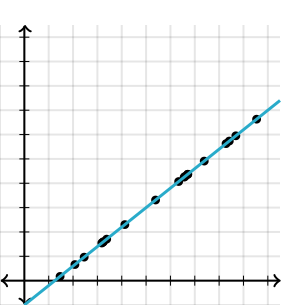 |
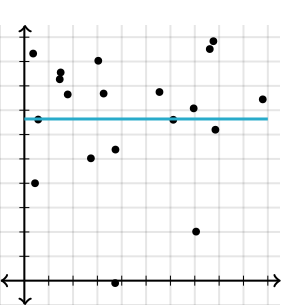 |
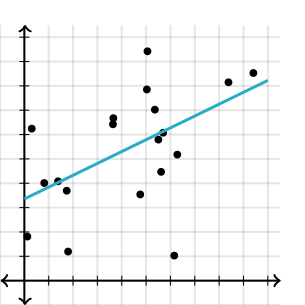 |
 |
 |
|---|---|---|---|---|
| [r=1], which is perfect positive correlation |
[r=0], which is no correlation |
[r=0.5], which is weak positive correlation |
[r=-0.5], which is weak negative correlation |
[r=-1], which is perfect negative correlation |