Understanding the ANOVA Test Results
How comparing “between” vs “within” variation tells us if group means truly differ?
Introduction
Imagine five classrooms, each trying a different study technique. At the end of the term, every student takes the same exam. You look at the average score in each class and wonder: Are these teaching methods really different, or are the average differences just random wiggles?
That question is exactly what ANOVA (Analysis of Variance) answers. ANOVA is a way to compare three or more group means by asking a simple-but-powerful question: Is the variation between group averages big compared to the natural variation within each group?
If “between” variation dwarfs “within” variation, at least one group mean is likely different. If not, the differences you see are probably just noise.
What ANOVA Tests?
- Null hypothesis (
): All groups have the same mean. - Alternative hypothesis (
): At least one group has a significantly different mean. - Big picture: How unusual is our data if H0 were true? ANOVA turns this into a single test statistic called F.
The F-statistic and p-value are derived from an Analysis of Variance (ANOVA) test, which compares the means of multiple groups to determine if at least one group is significantly different.
How ANOVA Works in Feature Selection: A Flowchart
START: Select a numerical feature (e.g., 'study_hours') and a categorical target (e.g., 'result')
I: Group Data:
- Split the dataset into groups based on each category of the target variable.(e.g., Group 1: 'Pass', Group 2: 'Fail')
II: Calculate Variances
- Calculate Variance BETWEEN groups (Signal)
- Calculate Variance WITHIN each group (Noise)
III: Compute F-Statistic
- Calculate the ratio of between-group variance to within-group variance.
IV: Determine Statistical Significance
- Calculate the p-value associated with the F-statistic.
- (A small p-value, typically < 0.05, means the result is statistically significant).
V: Rank and Select Features Repeat for all numerical features
- Rank them by their F-values (higher is better).
- Select the top-k features for your model.
Understanding the ANOVA Test Results
I had always been wondering the math behind Anova testing, which is one to be used for feature selection when we have Continuous Dependent Variable and Categorical Target Variable. Thus my attempt is to shot the math behind using the one example.
Sample data for this example is picked up from scipy’s documentation’s, f_oneway, which performs one-way ANOVA tests.
- Tillamook (10 values) =
- Newport (8 values) =
- Petersburg (7 values) =
- Magadan (8 values) =
- Tvarminne (6 values) =
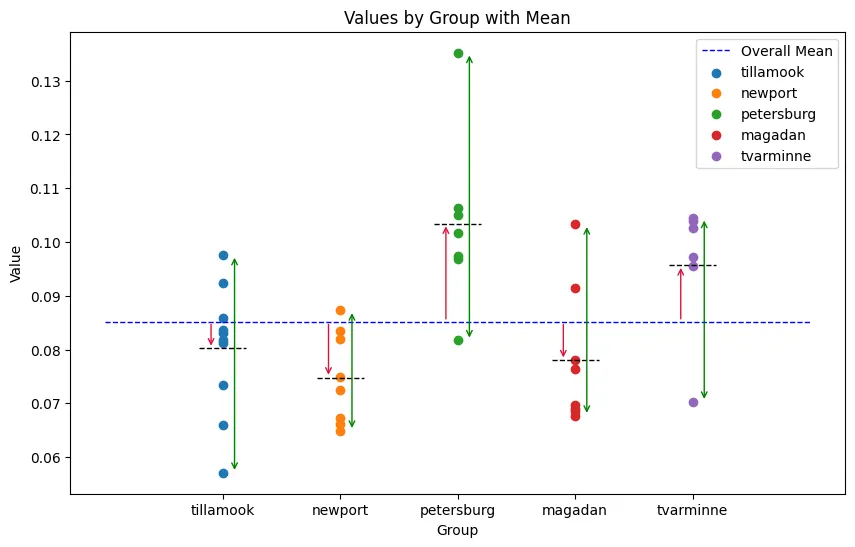
In above graph each group mean as a black dash on a line. Blue dashed line plots the grand mean. The red arrows from each grand mean to the group mean show “between-group” difference. If the null is true (all means equal), those arrows should be tiny. Green dash line represents the variance in each group.
ANOVA asks: Are the red arrows (between) meaningfully bigger than the green arrows (within)? If yes, the groups likely have different means.?
F-statistic Formula
Where:
- Between-group variance (
): Measures variability between different groups - Within-group variance (
): Measures variability within each group
★ Step 1: General Stats
- Number of Groups (k) and Total Observations (N):
- k=5 (Tillamook, Newport, Petersburg, Magadan, Tvarminne)
- N=39 (Total number of observations)
is data point in group
★ Step 2: Compute Mean
i. First, we calculate the mean (
- Tillamook (
): , - Magadan (
): , - Tvarminne (
): , - Petersburg (
): , - Newport (
) : ,
ii. Grand Mean (
★ Step 3: Compute Sum of Squares
i. Sum of Squares Between Groups (
Where
ii. Sum of Squares Within Groups (
This measures the "noise" or spread inside each individual group. We find the sum of squared differences from each group's own mean.
- Tillamook:
- Petersburg:
- Magadan:
- Tvarminne:
- Newport:
iii. Total Sum of Squares (
★ Step 4: Compute Mean Squares
Degrees of Freedom
-
-
-
Between-group variance (
): Measures variability between different groups
- Within-group variance (
): Measures variability within each group
★ Step 5: Compute the F-Statistic
The F-statistic is calculated as:
★ Step 6: (Final) p-value calculation
Once we compute the F-statistic, the p-value is obtained from the F-distribution:
- p-value = Probability of getting an F-statistic this extreme under the null hypothesis
- If p-value < α (0.05), reject
(at least one group is significantly different) - If p-value > α (0.05), fail to reject
(no significant difference)
- In our case when
, - Since p < 0.05, we reject the null hypothesis, meaning at least one group has a significantly different mean.
Interpreting Common Scenarios
- Low between-group variance, any within-group variance: Groups look similar. F small. Fail to reject H0.
- High between-group variance, low within-group variance: Clear separation. F very large. Reject H0.
- Unequal within-group variances across groups: Violates a key ANOVA assumption. Consider Welch’s ANOVA or nonparametric alternatives.
- High between-group variance, high within-group variance: Means differ, but overlap makes it harder. F may or may not be large. You need the ANOVA to decide.
Python Code
import numpy as np
from scipy.stats import f_oneway

tillamook = [0.0571, 0.0813, 0.0831, 0.0976, 0.0817, 0.0859, 0.0735, 0.0659, 0.0923, 0.0836]
newport = [0.0873, 0.0662, 0.0672, 0.0819, 0.0749, 0.0649, 0.0835, 0.0725]
petersburg = [0.0974, 0.1352, 0.0817, 0.1016, 0.0968, 0.1064, 0.105]
magadan = [0.1033, 0.0915, 0.0781, 0.0685, 0.0677, 0.0697, 0.0764, 0.0689]
tvarminne = [0.0703, 0.1026, 0.0956, 0.0973, 0.1039, 0.1045]

f_oneway(tillamook, newport, petersburg, magadan, tvarminne)
Output
F_onewayResult(statistic=np.float64(7.121019471642445), pvalue=np.float64(0.00028122423145345525))